How to Start a Surgical Disposable Wholesale Business in Pakistan
The surgical disposable business in Pakistan offers strong potential due to rising healthcare demands in hospitals, clinics, and diagnostic centers. Surgical disposables like syringes, gloves, masks, IV sets, catheters, and bandages are essential items with steady demand.
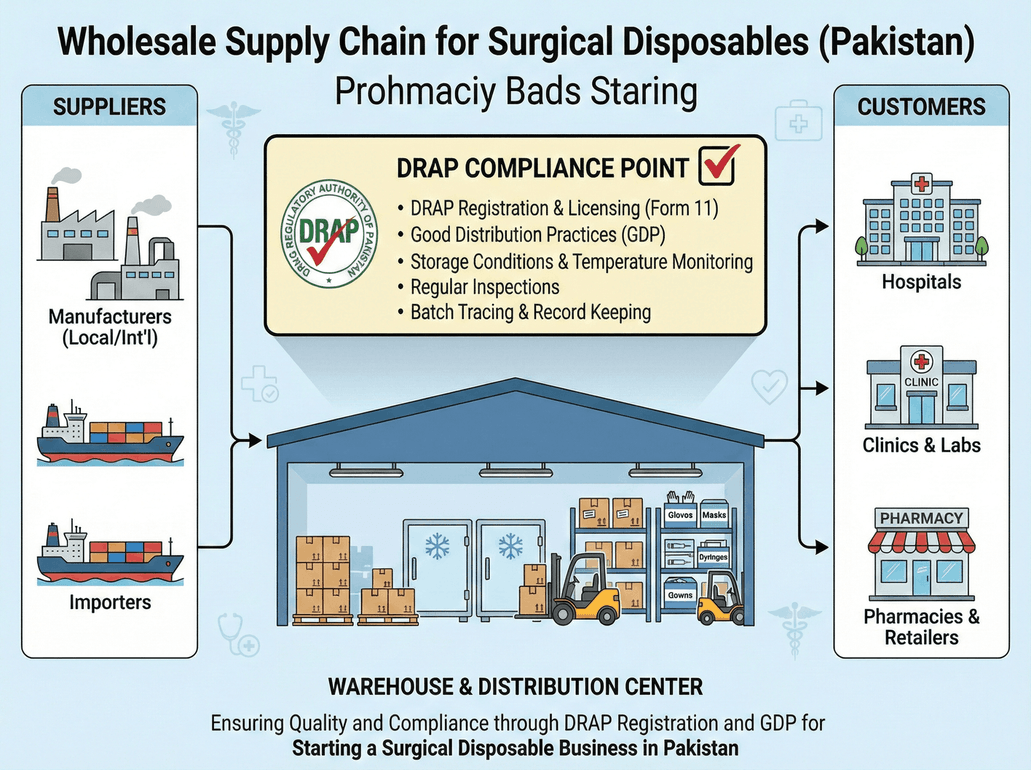
This guide focuses on starting as a wholesaler (distribution-focused) using the DSL (Drug Sale License) via Form 11 for pharmaceuticals/therapeutic goods wholesale, or Form 9 for pharmacy-related setups (often retail but adaptable). For pharma aspects involving drugs or combined products, Form 9 applies in some provincial contexts for supervision requirements.
If interested in importing, you'll need a separate import license (establishment license for medical devices from DRAP). For manufacturing, a manufacturing license with product registration is required next (not covered in depth here, as the focus is wholesale).
DRAP registration (or enlistment) ensures compliance for products, especially imported or higher-risk items. Many low-risk surgical disposables fall under medical devices regulated by DRAP's Medical Devices Division.
Why Start a Surgical Disposable Wholesale Business in Pakistan?
Pakistan's healthcare sector grows rapidly, with increasing hospitals and private clinics. The market for surgical disposables is driven by infection control needs post-pandemic and government health initiatives.
As a wholesaler, you supply to retailers, hospitals, and clinics without manufacturing. This lowers entry barriers compared to production.
Unique insight: Many new entrants overlook provincial variations in DSLissuance (e.g., Punjab vs. ICT), leading to delays. Start with your province's health department portal for faster processing.
Legal Framework and Regulatory Bodies
The Drugs Act 1976, DRAP Act 2012, and Medical Devices Rules govern this sector. DRAP oversees medical devices (including most surgical disposables) and drugs.
- DSL (Drug Sale License) is provincial for wholesale of drugs/therapeutic goods.
- Medical devices require DRAP establishment licenses for import/manufacture, but wholesale often falls under DSL if not importing directly.
- DRAP registration applies to products for quality assurance.
Step 1: Business Registration and Setup
Register your business entity first:
- Sole proprietorship or partnership via FBR for NTN.
- Private limited company via SECP for credibility in dealings.
Secure premises: A godown/warehouse (minimum 100-200 sq ft) with proper storage (cool, dry, pest-free). Install shelving, air conditioning if needed for sensitive items.
Obtain general licenses: NTN, sales tax registration (FBR), and local municipal approvals.
Step 2: Obtaining Drug Sale License (DSL) for Wholesale
To start as a wholesaler, apply for DSL (wholesale type).
Use Form 11 (application for license to sell/store/exhibit drugs by wholesale/distribution, under rules for supervision).
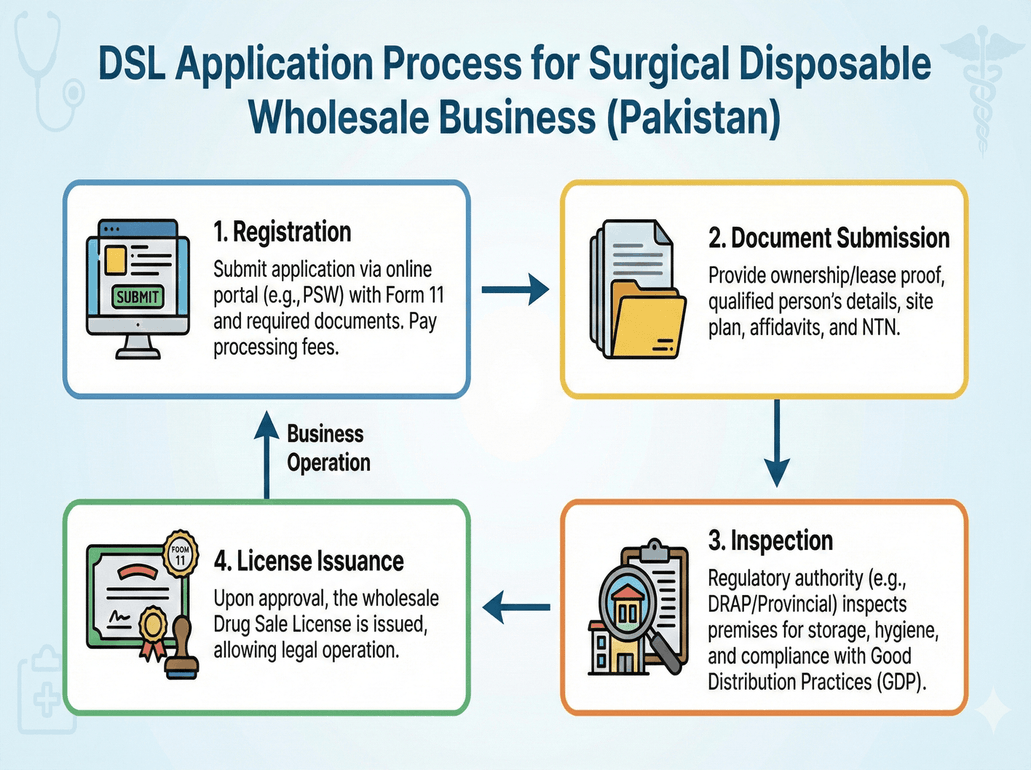
Process (provincial, e.g., Punjab/ICT via online portals):
- Register on the provincial portal.
- Fill online application with details: business name, address, qualified person (pharmacist/dispenser registered with Pharmacy Council).
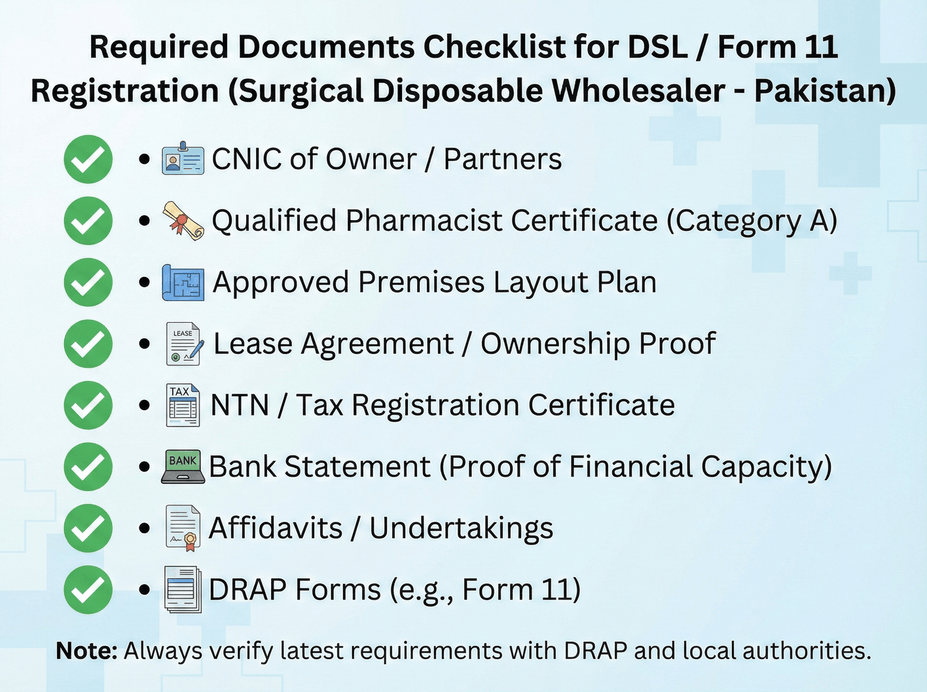
- Submit documents:
- CNIC copies, photos.
- Pharmacist registration (for supervision).
- Premises plan/layout.
- Affidavit of compliance with Drugs Act.
- Fee payment. The DSL is a provincial licence, so the fee is set by your province under the Drugs Act, 1976 rather than by DRAP — commonly quoted in the Rs. 5,000–10,000 range, but confirm the current figure and payment head with your provincial drug control authority before paying.
- Inspection by Drug Inspector.
- Approval and issuance of DSL on Form 11.
Form 9 often applies for retail/pharmacy setups (with qualified supervision), but wholesale/distribution uses Form 11 for broader sales to institutions.
Tip: For surgical disposables classified as medical devices, DSL suffices for local wholesale; no separate DRAP wholesale license needed unless importing.
Step 3: Sourcing Products and Suppliers
Source from local manufacturers or importers. Ensure products have DRAP registration or enlistment (check DRAP website lists). Under the Medical Devices Rules, 2017, devices are graded across four risk classes with Class A the lowest hazard and Class D the highest: Class A devices are enlisted (Form-6 for local manufacture, Form-6A for import) while Class B, C and D are registered (Form-7 and Form-7A respectively). Most surgical disposables sit in Class A. Every enlistment or registration is valid for five years, so ask a supplier for the certificate date, not just its existence.
Start small: Focus on high-demand items like surgical gloves, disposable syringes, face masks.
Build relationships with reliable suppliers offering competitive pricing and timely delivery.
Unique insight: Negotiate bulk deals with suppliers who handle DRAP compliance, reducing your risk of stocking unregistered items.
Step 4: If Interested in Importing Surgical Disposables
For direct importing:
- Obtain Establishment License to import medical devices from DRAP (Form-2, online via e.dra.gov.pk).
- Submit online application, hard copy, premises inspection.
- Valid for 5 years.
- Then, apply for product registration (Form-8/8A) or enlistment for low-risk items.
Import via customs with DRAP approvals. This step is next if wholesale expands to imports.
Step 5: Product Compliance and DRAP Registration
Many surgical disposables need DRAP registration(or provisional enlistment) for legal sale. Check DRAP's list of registered/enlisted devices.
As a wholesaler, stock only compliant products to avoid penalties. For pharma-related disposables (e.g., drug-coated), additional checks apply.
Step 6: Storage, Distribution, and Good Distribution Practices
Follow GDPMD (Good Distribution Practices for Medical Devices):
- Temperature-controlled storage.
- FIFO inventory.
- Proper labeling.
- Record-keeping for traceability.
Use software for stock management.
Step 7: Marketing and Sales Strategy
Target hospitals, clinics, pharmacies. Offer competitive pricing, reliable supply, credit terms.
Build online presence: Website showcasing products to drive traffic and inquiries. Attend healthcare expos.
Pro tip: Offer value-added services like just-in-time delivery to stand out.
Step 8: Financial Planning and Investment
- Initial investment: Rs. 5-20 lakhs (premises, stock, licenses).
- Ongoing: Inventory, transport, staff (sales, accountant).
- Aim for 20-30% margins on wholesale.
Step 9: Challenges and Risk Management
- Regulatory changes: Stay updated via DRAP notifications.
- Competition: Differentiate with quality and service.
- Counterfeits: Verify suppliers.
Unique insight: Post-2025 digital portals speed up DRAP processes. Use them early to gain advantage over traditional applicants.
Step 10: Scaling Your Business
Once established, consider adding imports or related products. Explore exports if compliant.
Quick Takeaways
- Register business entity and premises first.
- Apply for DSL using Form 11 for wholesale distribution.
- Use Form 9 contexts for pharma supervision if applicable.
- Ensure all products have DRAP registration.
- For importing, secure DRAP import license next.
- Focus on compliant sourcing and storage.
- Build supplier networks for steady stock.
FAQs
1. What is the difference between Form 11 and Form 9 for DSL in Pakistan?
Form 11 is typically for wholesale/distribution licenses (sell to institutions), while Form 9 relates to retail/pharmacy setups with supervision requirements. Use Form 11 for surgical disposable wholesale business.
2. Do I need DRAP registration for all surgical disposables in wholesale?
Yes, most require DRAP registration or enlistment for legal sale. Check DRAP lists to avoid unregistered stock.
3. How long does it take to get DSL for wholesale?
Usually 1-3 months, depending on inspection and province. Online portals speed it up.
4. Can I start wholesale without importing?
Yes. Source locally from licensed suppliers. Import license from DRAP is only required if you import directly.
5. What if my products include pharma elements?
Apply under pharma rules with Form 9/supervision; ensure qualified pharmacist oversight.
Ready to start?
Starting a surgical disposable business as a wholesaler in Pakistan is achievable with proper licensing via DSL and compliance.
Sources
Fees, validity periods and form numbers on this page are taken from the documents below. DRAP revises fee schedules and procedures from time to time — verify current figures against the primary source before you budget or apply.
- Medical Devices Rules, 2017 (full text, PDF) — Drug Regulatory Authority of Pakistan. Notified 16 January 2018. Fee schedule at Schedule C (see rule 63); application forms at Form-1, Form-2, Form-6, Form-6A, Form-7 and Form-7A.
- Medical Devices Establishment Licences — DRAP. Licence categories and the five-year validity period.
- Medical Devices — Application Process — DRAP. Application route and the Medical Device Board as competent authority.
- MDMC online licensing system (e.dra.gov.pk) — DRAP's online portal for establishment licence and product applications.
Related Guides
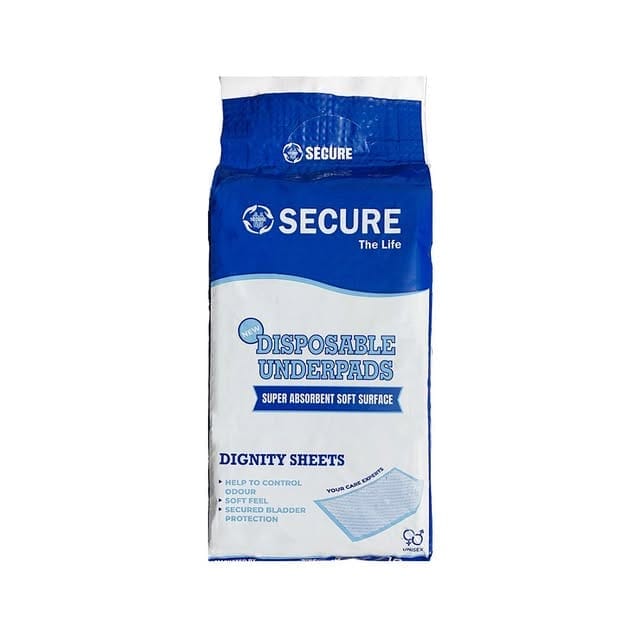
What a dignity sheet is, why it has that name, where it is used on the ward and in theatre, how to specify absorbency and size, and what to check before buying in bulk.
Read Guide →Who needs a Drug Sale License, how Form 11 differs from Form 9, the documents and pharmacist requirement, what a Drug Inspector checks, and how the DSL fits with DRAP licensing.
Read Guide →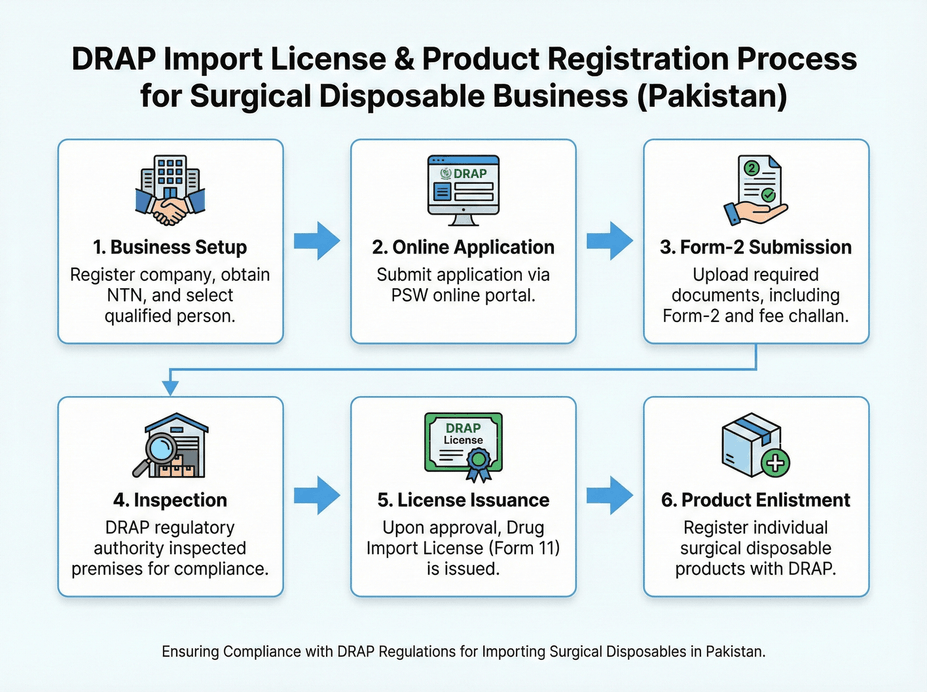
A practical guide on securing the Establishment License to Import (Form-2) and product registration for surgical disposables.
Read Guide →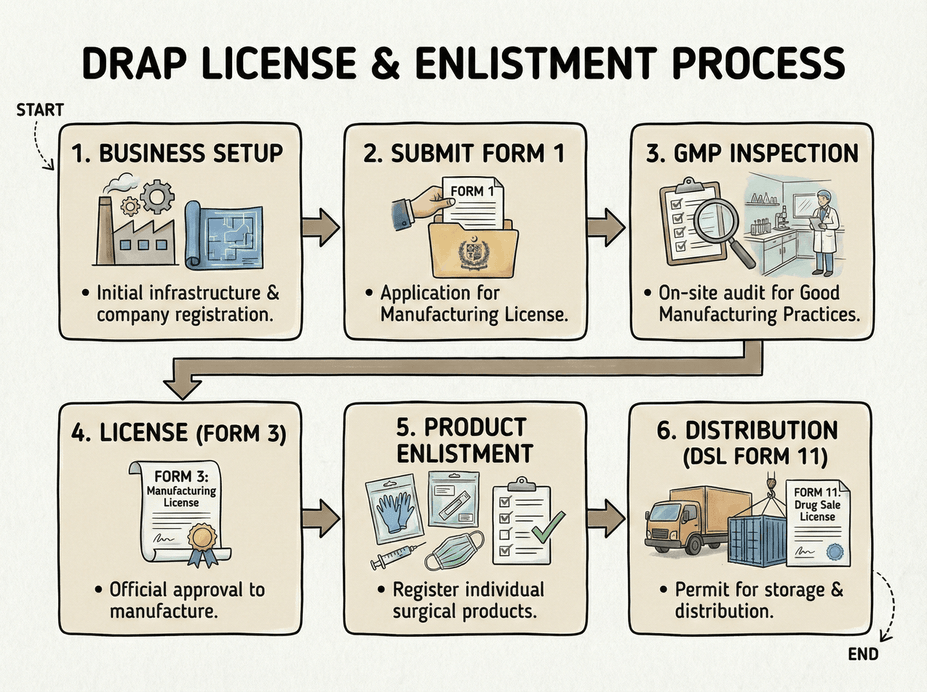
Start your manufacturing unit with our guide on DRAP Manufacturing License (Form 1) and product enlistment.
Read Guide →