
How to Obtain DRAP Import License and Product Registration for Surgical Disposable Business in Pakistan
The surgical disposable business in Pakistan is highly lucrative, especially when expanding from wholesale to importing high-quality items like disposable syringes, surgical gloves, IV cannulas, face masks, catheters, and bandages.
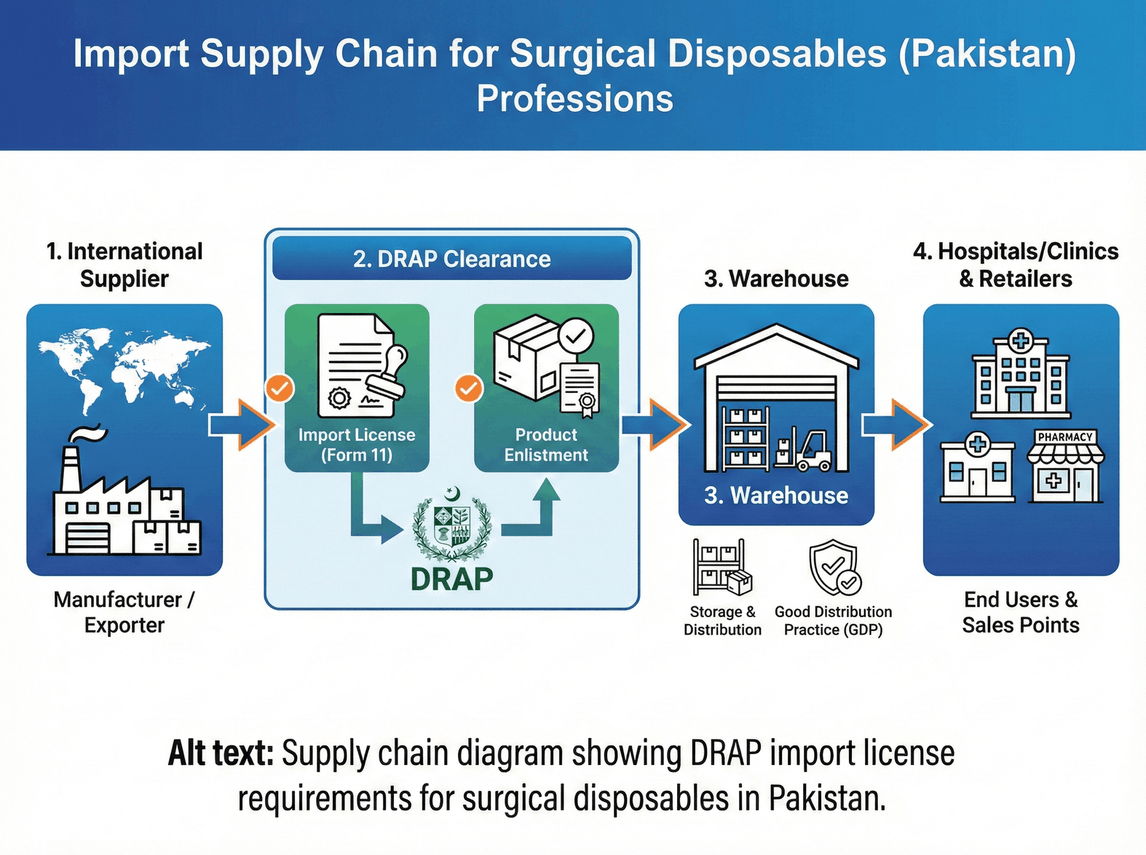
Importing allows access to international standards, better pricing, and variety, meeting the growing demand in hospitals and clinics.
This guide covers the import registration process regulated by the Drug Regulatory Authority of Pakistan (DRAP). to legally import and sell surgical disposables (classified as medical devices under the Medical Devices Rules 2017), you must first secure an Establishment License to import (often called DRAP import license), followed by product registration or enlistment.
Note: This builds on wholesale setup with DSL (via Form 11). Many low-risk surgical disposables (Class A) follow simplified enlistment, while higher-risk items require full registration. The process uses the modern MDMC Online System for faster approvals.
Unique insight: As of recent updates, DRAP's digital portal (e.dra.gov.pk) has significantly reduced processing times. Many applicants now complete establishment licensing in under 180 days with proper preparation, giving early importers a competitive edge in the market.
Why Import Surgical Disposables in Pakistan?
Pakistan's healthcare sector is expanding rapidly, with increasing private hospitals and emphasis on infection control. Imported surgical disposables often meet international certifications (e.g., CE, ISO), building trust and allowing higher margins.
Importing directly cuts intermediaries, but requires strict compliance to avoid customs delays or penalties.
Legal Framework for Importing Medical Devices
The DRAP Act 2012, Medical Devices Rules 2017, and related guidelines govern imports. DRAP's Medical Devices Division oversees this. Key requirements:
- Valid Establishment License to import (Form-2 application).
- Product enlistment (Class A) or registration (Class B/C/D).
- Compliance with Good Distribution Practices for Medical Devices (GDPMD).
Surgical disposables like gloves and syringes are typically Class A (low risk), simplifying the process.
Step 1: Business Preparation Before Applying for Import License
Ensure your business is ready:
- Register as a private limited company (SECP) for credibility.
- Secure NTN, sales tax registration (FBR).
- Have suitable premises: Warehouse with proper storage (temperature-controlled, pest-free, adequate space).
- Appoint qualified staff (e.g., technical personnel familiar with medical devices).
Without these, your DRAP import license application will be rejected.
Step 2: Applying for Establishment License to Import (DRAP Import License)
This is the first mandatory step. The license is valid for 5 years and issued by the Medical Device Board (MDB).
Process:
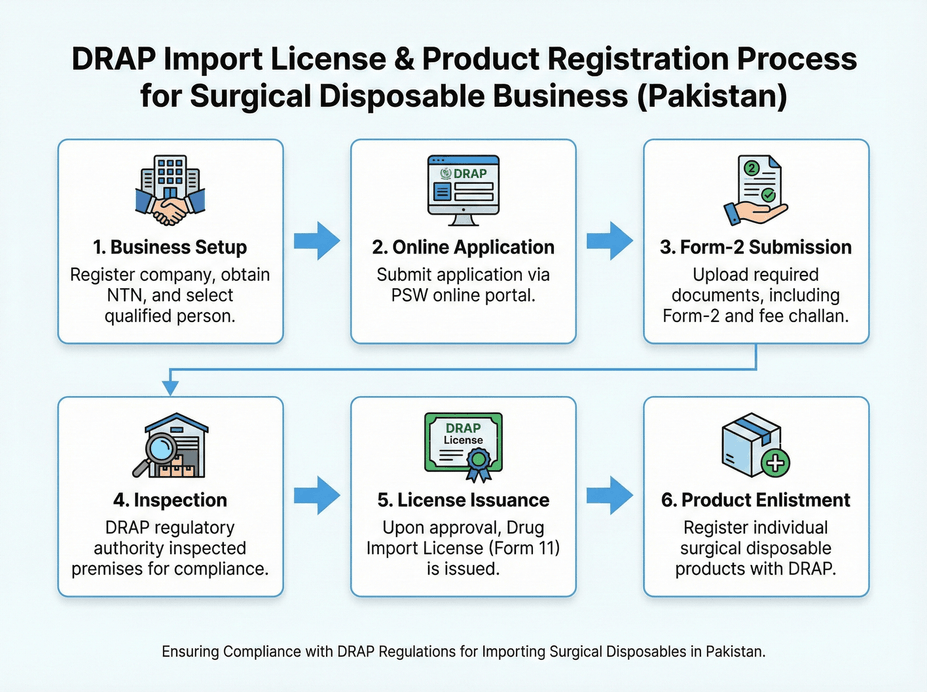
- Register on the MDMC Online System at e.dra.gov.pk.
- Submit online application for Establishment License to Import.
- Download and fill Form-2 (Application for Grant or Renewal of an Establishment License to Import Medical Devices).
- Prepare and upload required documents (see checklist below).
- Submit hard copy of the application to Medical Devices Division, DRAP.
- Pay the prescribed fee — Rs. 20,000 for an establishment licence to import medical devices (Schedule C, Medical Devices Rules, 2017).
- Allow premises inspection by DRAP panel for GDPMD compliance.
- Approval by MDB and issuance of license.
Tip: Focus on storage facilities. Many rejections occur due to inadequate premises.
Step 3: Required Documents for DRAP Import License Application
Key documents include:
- CNIC and photos of applicant/owners.
- Business registration certificates (SECP/NTN).
- Premises layout plan and ownership/lease proof.
- List of intended surgical disposables to import (categories/names).
- Qualified person's details (technical staff).
- Declaration and undertaking on stamp paper (as per Form-2).
- Fee payment proof.
Step 4: Product Registration/Enlistment After Import License
With the Establishment License, proceed to register/enlist products.
The Rules operate a four-class risk system in which Class A represents the lowest hazard and Class D the highest. Which form you file depends on both the class and on whether you import or manufacture locally — importers use the “A” variants:
- Class A (most surgical disposables): simplified enlistment via Form-6A — “Application form for enlistment or renewal of Class-A medical device or accessory or component for import”. Form-6 is the equivalent for local manufacture.
- Class B, C and D: full registration via Form-7A for import; Form-7 for local manufacture.
Cotton wool is given in the Rules as an example of a Class A device; non-medicated impregnated gauze sits in Class B. Most of what a surgical disposables importer handles falls in Class A.
Prescribed fees for importers
Set out in Schedule C of the Medical Devices Rules, 2017 (see rule 63). All figures in Pakistani Rupees:
| Activity | Fee | Renewal |
|---|---|---|
| Establishment licence to import medical devices | Rs. 20,000 | Rs. 10,000 |
| Enlistment of a Class A device (importer) | Rs. 5,000 | Rs. 5,000 |
| Registration of a Class B device (importer) | Rs. 25,000 | Rs. 12,500 |
| Registration of a Class C or D device (importer) | Rs. 50,000 | Rs. 25,000 |
| Import permit | Rs. 5,000 | Rs. 5,000 |
| Post-enlistment or post-registration variation | Rs. 5,000 | — |
A change in particulars of a licensed establishment is charged at fifty percent of the licensing fee, and a change in particulars of an enlisted or registered device at fifty percent of the registration fee. Both the establishment licence and the enlistment or registration are valid for five years from issuance unless earlier suspended or cancelled. Fee schedules are revised periodically — check the current Schedule C before budgeting.
Submit:
- Manufacturer authorization.
- Free Sale Certificate, Declaration of Conformity, CE/ISO certificates.
- Technical documentation.
- Labeling in English (and Urdu where required).
Unique insight: For Class A items, provisional enlistment can allow faster market entry. Many importers use this to test demand while completing full processes.
Step 5: Importing Process and Customs Clearance
Once licensed and products registered:
- Notify arrival via Form-11 (Intimation of Arrival).
- Provide Bill of Lading, Invoice, Packing List.
- Obtain clearance certificate from DRAP field office.
- Clear customs with DRAP approvals.
Step 6: Good Distribution Practices and Storage
Comply with GDPMD (Good Distribution Practices for Medical Devices):
- Temperature/humidity control.
- FIFO inventory.
- Traceability records.
This is inspected during licensing and ongoing.
Step 7: Marketing and Scaling Your Import Business
Use imports for premium branding. Target hospitals, offer samples, build an online catalog.
Pro tip: Partner with international suppliers holding CE certification to ease documentation.
Step 8: Challenges and Best Practices
- Delays in inspection: Prepare premises meticulously.
- Changes in rules: Monitor DRAP notifications.
- Counterfeits: Source from verified manufacturers.
Unique insight: Recent digital enhancements mean proactive applicants using the portal early gain faster approvals compared to paper-based ones.
Quick Takeaways
- Secure DRAP import license first via Form-2 and online system.
- Obtain product enlistment/registration next for each surgical disposable.
- Ensure premises comply with GDPMD for inspection success.
- Use digital portal for faster processing.
- Import only after full compliance to avoid customs issues.
- Focus on Class A disposables for simpler enlistment.
FAQs
1. What is the DRAP import license, and why is it required for surgical disposables?
The DRAP import license (Establishment License to Import Medical Devices via Form-2) is mandatory for any importer. It authorizes your business to bring in surgical disposables legally, followed by product registration.
2. How long does it take to get the DRAP import license?
Typically up to 180 days, including inspection. Using the online MDMC system speeds up submission and tracking.
3. Do all surgical disposables need full registration, or is enlistment enough?
Most low-risk items like disposable gloves and syringes (Class A) require simplified enlistment (Form 6-A), while higher-risk need full registration (Form 7-A).
4. Can I import without product registration if I have the import license?
No. Imports require both DRAP import license and product enlistment/registration. Start with license, then register products.
5. What documents are key for Form-2 DRAP import license application?
Include premises plan, NTN, business registration, list of devices, declaration on stamp paper, and fee proof. Use DRAP's official checklist.
Start Importing Today
Expanding your surgical disposable business through importing is a strategic move. Start with the DRAP import license and product DRAP registration.
Sources
Fees, validity periods and form numbers on this page are taken from the documents below. DRAP revises fee schedules and procedures from time to time — verify current figures against the primary source before you budget or apply.
- Medical Devices Rules, 2017 (full text, PDF) — Drug Regulatory Authority of Pakistan. Notified 16 January 2018. Fee schedule at Schedule C (see rule 63); application forms at Form-1, Form-2, Form-6, Form-6A, Form-7 and Form-7A.
- Medical Devices Establishment Licences — DRAP. Licence categories and the five-year validity period.
- Medical Devices — Application Process — DRAP. Application route and the Medical Device Board as competent authority.
- MDMC online licensing system (e.dra.gov.pk) — DRAP's online portal for establishment licence and product applications.
Related Guides
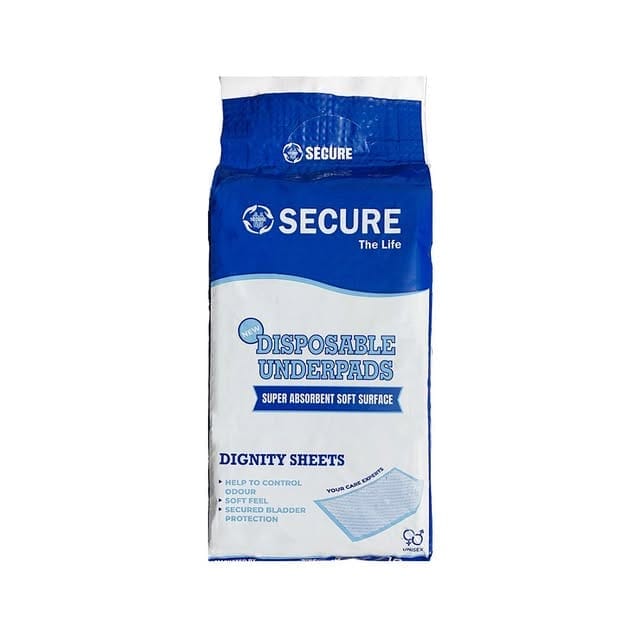
What a dignity sheet is, why it has that name, where it is used on the ward and in theatre, how to specify absorbency and size, and what to check before buying in bulk.
Read Guide →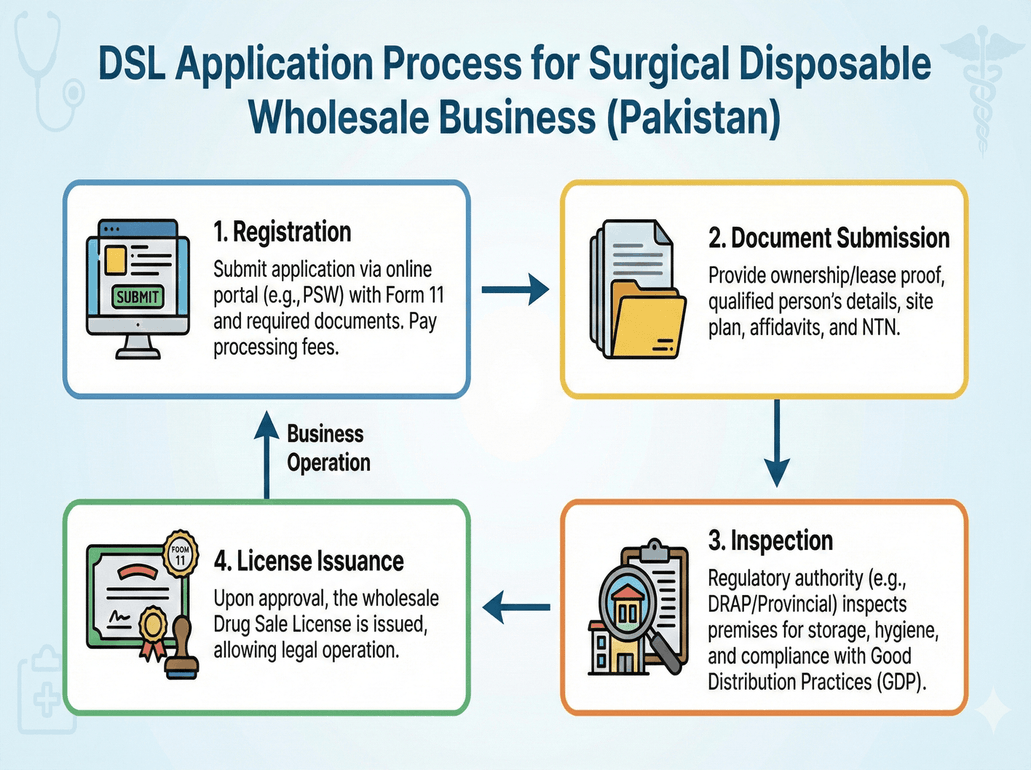
Who needs a Drug Sale License, how Form 11 differs from Form 9, the documents and pharmacist requirement, what a Drug Inspector checks, and how the DSL fits with DRAP licensing.
Read Guide →Learn the step-by-step process of starting a wholesale business (DSL Form 11) and navigating local regulations effectively.
Read Guide →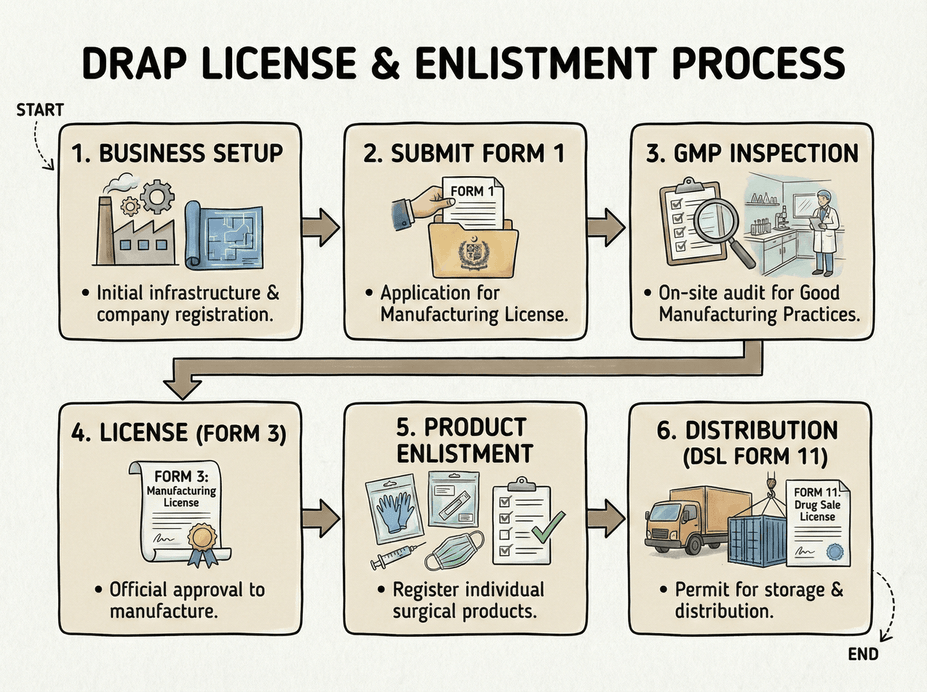
Start your manufacturing unit with our guide on DRAP Manufacturing License (Form 1) and product enlistment.
Read Guide →